
Visa vs Coinbase: The Internet AI Agents Will Use
Major financial and crypto platforms are preparing for a future where artificial intelligence agents interact directly with digital payments and online services. Two companies at the center of this shift are Visa and Coinbase, but their approaches suggest very different visions for how the next generation of the internet could function.
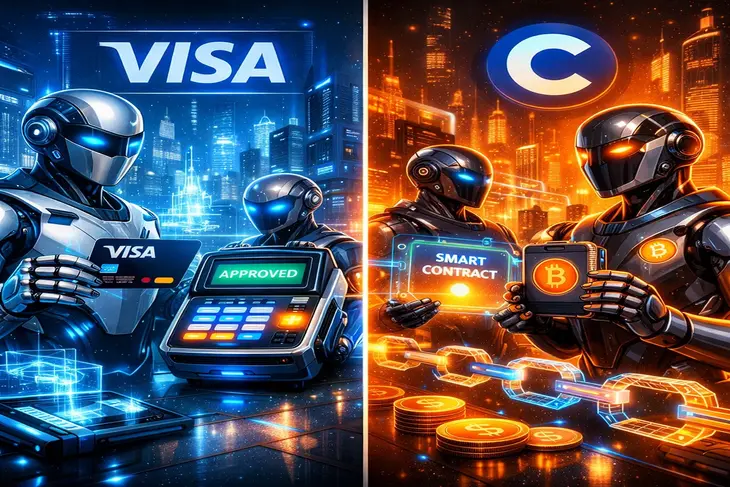
Visa, one of the world’s largest payment networks, is exploring systems that allow AI agents to make purchases and manage payments on behalf of users. In this model, AI assistants could automatically handle routine transactions such as subscriptions, travel bookings, or online shopping. The idea is to combine AI decision making with Visa’s existing global payment infrastructure, allowing automated systems to securely verify identities, approve spending limits, and process transactions instantly. Essentially, Visa is adapting the traditional financial system so AI can operate inside it.
Coinbase, on the other hand, is building tools that lean heavily on blockchain technology. Its approach focuses on enabling AI agents to operate with crypto wallets, allowing them to send and receive digital assets directly on decentralized networks. Instead of relying on banks or centralized payment rails, these AI systems would interact with smart contracts, decentralized apps, and blockchain-based services. In this environment, AI agents could autonomously pay for data, computing power, or online services using cryptocurrency.
The contrast between the two strategies highlights a broader debate about the future of the internet. Visa’s vision builds on the existing financial ecosystem, extending traditional payment networks so AI can use them efficiently. Coinbase is betting on a more open and decentralized digital economy where AI agents transact freely using blockchain-based money.
Both directions aim to prepare for a world where AI systems perform tasks, negotiate services, and handle payments without constant human involvement. As AI technology advances, the infrastructure behind digital payments will likely determine how these agents interact with the online economy.
Whether the future leans toward centralized financial rails or decentralized crypto networks, one thing is becoming clear: the internet of tomorrow may not just be used by humans, but by intelligent machines acting on their behalf.
