
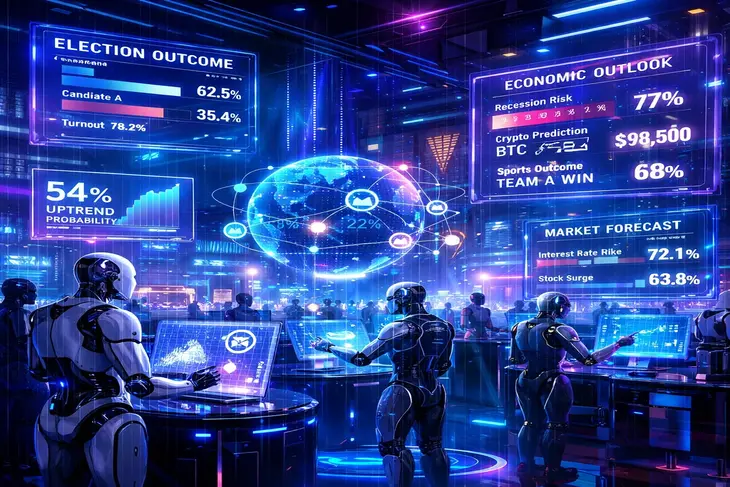
AI Bots Are Taking Over Prediction Markets
Artificial intelligence is beginning to reshape prediction market trading in ways many traders are only starting to notice. Instead of relying solely on human judgment, an increasing number of participants are deploying AI agents that can analyze large volumes of data, detect patterns, and execute trades automatically. These systems are designed to process information faster than any individual trader, giving them an advantage in markets where timing and probability estimates are critical.
Prediction markets, which allow users to bet on the likelihood of future events, have traditionally depended on the collective wisdom of human participants. Traders would interpret news, economic indicators, and public sentiment to estimate the probability of outcomes ranging from elections to financial events. AI agents are now entering that space, introducing a new layer of automation and analytical power. By continuously scanning social media, news reports, blockchain data, and market signals, these tools can adjust positions in real time as new information appears.
What makes AI agents particularly influential is their ability to operate nonstop. Unlike human traders who react periodically, AI-driven systems can update predictions and trade within seconds of detecting a shift in sentiment or data. Some developers are even building autonomous agents that manage entire trading strategies without direct human intervention. These bots can rebalance positions, hedge risks, and optimize portfolios across multiple prediction platforms.
However, the growing presence of AI in prediction markets is also raising questions. Market participants and analysts are beginning to debate whether automated trading could distort market signals or concentrate advantages among those with access to advanced technology. If large numbers of AI agents follow similar data models, their actions could amplify trends or trigger rapid swings in probability pricing.
Despite these concerns, many industry observers believe AI-powered trading could ultimately improve market efficiency. By quickly incorporating new information into pricing, these systems may help prediction markets become more accurate reflections of real-world probabilities. As AI technology continues to evolve, its influence on forecasting platforms is likely to expand, quietly transforming how traders predict the future.
